Most safety shoes feel fine when the shift begins.
The real test starts after a few hours.
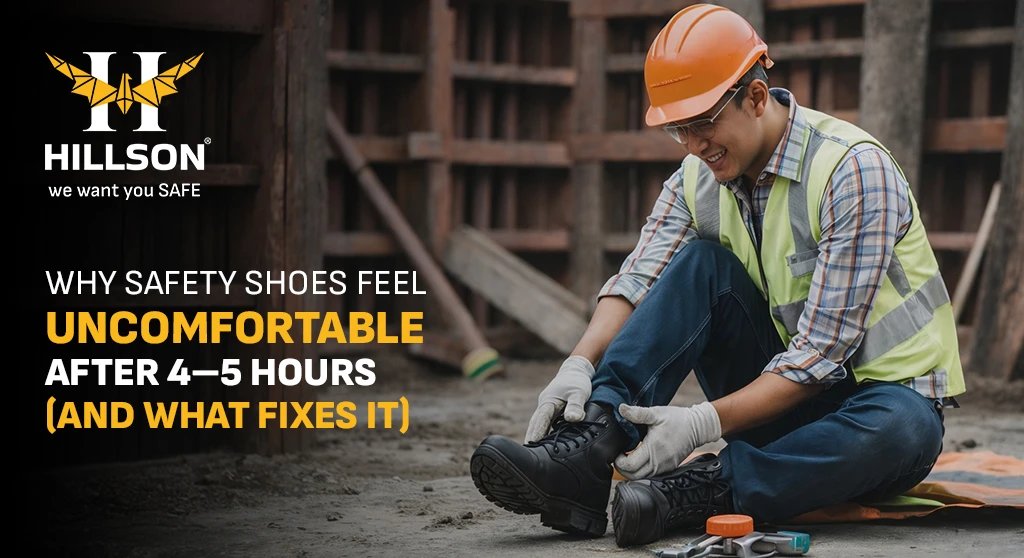
By hour four or five, discomfort sets in pressure builds, fatigue increases, and focus starts shifting from work to relief. This isn’t just about comfort. It’s about performance, safety, and long-term impact.
The question is not why workers feel discomfort.
The real question is—why the footwear fails to support them long enough.
The Science Behind Fatigue
Industrial work is not static. It involves:
Every step creates micro-impact stress.
Over time, this stress accumulates in:
Heel pressur
Arch strain
Forefoot compression
Most safety shoes are designed to protect from external hazards,
but not all are built to manage internal fatigue.
That’s where the problem begins.
Pressure Points: The Hidden Problem
Discomfort doesn’t come from the entire foot.
It comes from specific pressure zones:
Heel → absorbs repeated impact
Midfoot → requires structural support
Forefoot → handles forward movement pressure
When a shoe lacks proper distribution,
👉 pressure concentrates instead of dispersing
Result:
Burning sensation
Foot fatigue
Reduced stability
Cushion vs Structure: The Real Balance
A common misconception is:
👉 “More cushioning = more comfort”
But excessive cushioning without structure leads to:
Instability
Energy loss
Faster fatigue
On the other hand, too much rigidity results in:
Stiffness
Pressure buildup
Discomfort over time
The real solution lies in balance:
Without both working together, comfort doesn’t last.
Why Most Safety Shoes Fail After a Few Hours
Because they are designed for:
Initial comfort
Basic protection
Not for:
They perform well at hour one.
They fail by hour five.
What Actually Fixes It
Long-lasting comfort is not a feature.
It’s a result of engineering decisions:
Even weight distribution
Impact absorption across the sole
Structural support for foot alignment
Flexibility where movement demands it
When these elements work together,
👉 fatigue is delayed
👉 performance remains consistent
The CL-07 Perspective
CL-07 is not designed for the first impression.
It is designed for the last hour of the shift.
Because in real work environments,
comfort at the beginning doesn’t matter.
Consistency throughout the day does.
Conclusion
Discomfort after 4–5 hours is not normal.
It’s a design gap.
When safety footwear is built to handle time, pressure, and movement together,
comfort becomes invisible—and performance becomes consistent.