One factory. Hundreds of workers. Different jobs. Different risks.
An assembly-line operator may spend hours standing at one workstation. A maintenance technician may move between machinery and service areas. A machining worker may work around oils and coolants, while an electronics or battery-related team may work around processes where static control matters.
They may all work in the same automotive plant.
But they may not need the same safety footwear.
That is why choosing the right automotive factory safety shoes is more than a simple procurement decision. The right footwear needs to match the work being performed, the hazards involved and the environment in which it is used.
And as automotive manufacturing expands into EV production, some footwear requirements can become even more specialised.
One Factory, Different Footwear Requirements
An automotive manufacturing facility is rarely one uniform workplace.
A single plant can include assembly lines, machining areas, maintenance zones, warehouses, material-handling sections and specialised electronics or battery-related operations.
Each area can expose workers to different conditions.
So, footwear selection should start with a simple question:
What does the worker actually face during the workday?
The answer can vary significantly from one department to another.
Assembly Lines
Assembly workers may spend long periods standing and walking on hard industrial floors.
For them, factors such as:
can all be important.
Machining Areas
Machining environments may involve machinery, heavy components, oils and coolants.
Here, protection and suitable outsole performance can become particularly important, especially where workers encounter potentially slippery surfaces.
Maintenance Teams
Maintenance Teams often move between different areas of a facility.
Their footwear may need to accommodate changing work conditions rather than being selected for just one fixed workstation.
EV and Electronics-Related Areas
Some EV manufacturing processes involve electrical and electronic components where controlling electrostatic discharge may be important.
However, that does not mean every EV manufacturing worker automatically needs ESD footwear.
The requirement depends on the specific process, equipment, materials and workplace risk assessment.
What Should Automotive Safety Shoes Provide?
Once the work environment is understood, the next step is identifying the protection and performance requirements.
Toe Protection
Automotive manufacturing involves tools, machinery, components and heavy parts that can create impact or compression hazards.
Protective toe caps are designed to provide protection against specified workplace impacts and compression.
The important point is to select the level of protection required for the actual application, rather than choosing footwear simply because it has a steel or composite toe.
Slip Resistance
Production floors can become challenging when oils, coolants or other liquids are present.
A suitable slip-resistant outsole can help provide grip and stability while workers move around the facility.
The required performance should be checked against the actual workplace conditions and the footwear's technical specifications.
Comfort for Long Shifts
Safety footwear may be worn for most of the working day.
Workers who spend hours standing or walking can be affected by footwear that is unnecessarily heavy or poorly fitted.
Factors such as:
Overall weight
Foot support
Cushioning
Flexibility
Breathability
Fit and sizing
can therefore influence everyday wearability.
Lightweight construction can improve wearability, but it should never come at the expense of the protection required for the job.
What Changes in EV Manufacturing?
Electric vehicle manufacturing shares many workplace hazards with conventional automotive production, but some processes introduce additional electrical and electronic considerations.
Battery manufacturing, electronics assembly and other specialised operations may involve areas where static control is important.
This is where EV manufacturing plant PPE needs to be considered carefully.
Anti-Static vs ESD Footwear
These terms are sometimes used interchangeably, but they are not necessarily the same.
Anti-static footwear is designed to help dissipate static charge and reduce the accumulation of electrostatic charge.
ESD footwear is used as part of an electrostatic discharge control system for environments where controlling static discharge is particularly important.
For EV, electronics and other static-sensitive processes, the specific requirements of the work area should be established before selecting footwear.
And footwear should not be considered separately from the wider ESD system. Flooring, grounding arrangements and other controls can also play a role.
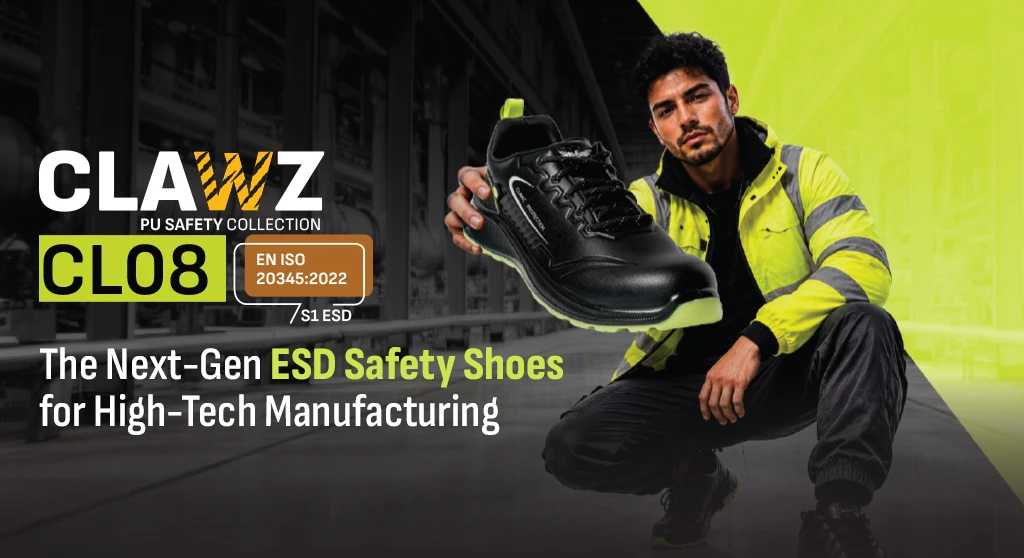
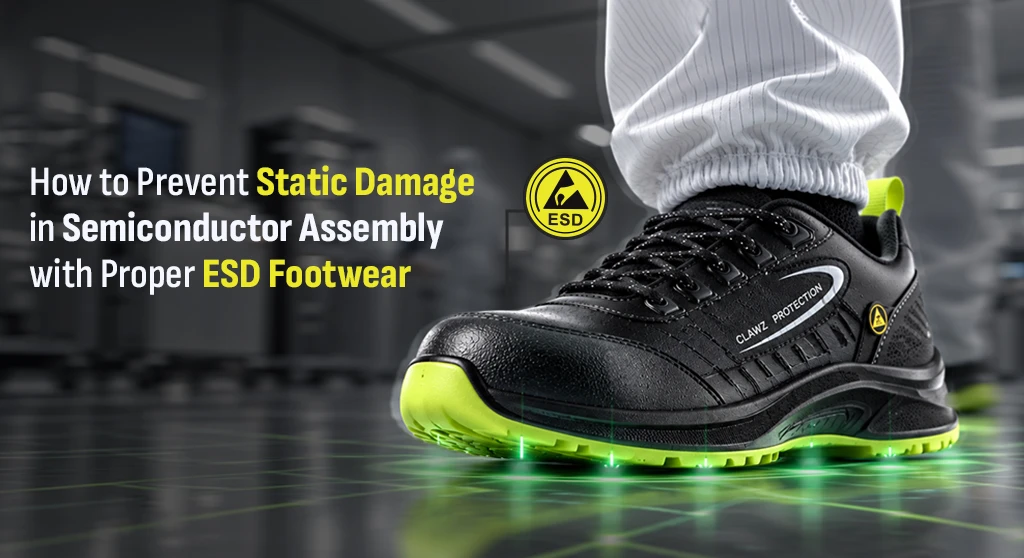
For workplaces where ESD protection is required, In Hillson’s CLAWZ CL-08, safety footwear is designed with ESD protection and a Non-Metallic design. Its product specifications also include a composite toe, low-ankle and dual-density PU sole.
Why One Footwear Specification May Not Fit Every Team
It can be tempting for large manufacturing facilities to standardise one safety shoe across the entire workforce.
But different roles can involve different hazards.
An assembly worker may prioritise long-shift comfort and protection. A machining worker may need footwear suited to areas where oils and coolants are present. A maintenance technician may need footwear that works across multiple environments.
Meanwhile, specialised electronics or battery-related areas may have additional static-control requirements.
Standardisation can simplify procurement, but the specification still needs to match the work.
The goal should be to find the right balance between consistency and application-specific requirements.
What Should Procurement and EHS Teams Check?
Before selecting automotive factory safety shoes, procurement and EHS teams should consider:
1. Workplace Hazards
Identify the actual risks workers encounter in each area.
2. Required Protection
Check the required level of toe protection and other relevant safety characteristics.
3. Outsole Performance
Consider the working surfaces and exposure to oils, coolants, water or other liquids.
4. Static-Control Requirements
Determine whether standard, anti-static or ESD footwear is appropriate for the specific work area.
5. Fit and Comfort
Consider working hours, standing requirements, walking distance and the range of sizes required across the workforce.
6. Materials and Construction
The upper, sole and other components should be suitable for the conditions in which the footwear will be used.
7. Applicable Standards
Verify the standards and certification associated with the specific footwear model and make sure they match the intended application.
8. Bulk Procurement
For large automotive and EV facilities, consistency in specifications, sizing and quality becomes important when supplying footwear across a large workforce.
How Hillson Supports Automotive Workplaces
Choosing safety footwear becomes easier when the range is built around different workplace requirements.
Hillson offers safety footwear across multiple industrial applications and specifically lists the automobile industry among the industries it serves. Its product range includes different safety footwear categories and models designed for varying workplace requirements.
For automotive and EV manufacturing teams, this means footwear can be evaluated based on the work environment, required protection and specific application rather than treating every worker and every department the same.
The focus is simple: understand the work first, then choose the footwear that fits it.
Match the Footwear to the Work
There is no single pair of safety shoes that is automatically suitable for every automotive or EV manufacturing environment.
The right choice depends on the hazards, processes, work areas and requirements of the people using the footwear.
For some workers, impact protection and slip resistance may be the priority.
For others, long-shift comfort or static control may matter more.
The best approach is to start with the workplace, understand the risks and then select footwear that meets those specific requirements.
Conclusion
An automotive factory is not just one workplace.
It is a collection of different environments, processes and people — each with its own footwear requirements.
As EV manufacturing introduces more specialised electrical and electronic processes, selecting the right PPE becomes even more important.
For manufacturers, choosing automotive factory safety shoes should therefore be about more than durability or appearance. It should be about matching the footwear to the work, the risks and the people wearing it.
Because the right safety footwear doesn't simply fit the worker.
It fits the work.