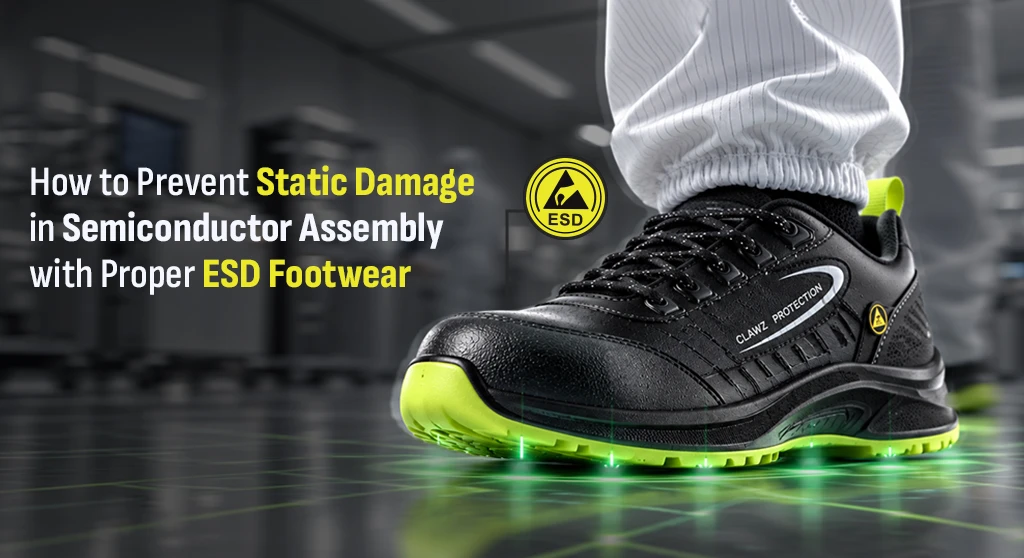
You may not see static electricity. You may not even feel it. But a tiny electrostatic discharge can still affect sensitive electronic components.
That makes static control an important part of semiconductor and electronics manufacturing.
In these environments, components, equipment and materials can be exposed to electrostatic charge during everyday movement and handling. The challenge is that ESD damage isn't always immediately visible. A component may continue to function after an event while its reliability has already been affected.
So, how do manufacturers reduce this risk?
One part of the answer is ESD footwear for electronics assembly — but only when it is used as part of a properly designed ESD control system.
Why Static Control Matters in Semiconductor Assembly
Semiconductor manufacturing involves highly sensitive processes and materials.
Electrostatic discharge can damage products and reticles, while electrostatic attraction can also cause particles to accumulate on charged surfaces. This makes static control relevant not only to product protection but also to the manufacturing environment itself.
For facilities handling ESD-sensitive devices, static control therefore needs to extend across the production environment rather than focusing on a single piece of equipment or PPE.
Where Does ESD Footwear Come In?
Workers constantly move through manufacturing environments.
Every step creates an interaction between the person, footwear and floor. When the appropriate footwear is used with a suitable flooring system, it can provide a controlled path for dissipating electrical charge from the person.
But there is an important distinction:
ESD footwear is not an ESD programme by itself.
The performance of footwear depends on its interaction with the flooring and the overall personnel-grounding system. Simply buying a shoe labelled “ESD” does not automatically establish effective static control.
That's why footwear needs to be selected as part of the complete system.
Semiconductor Cleanrooms Need More Than ESD Protection
A semiconductor cleanroom isn't simply an electronics production area with stricter cleanliness.
The environment may need to control:
Electrostatic charge
Particle contamination
Materials used around sensitive processes
Worker movement
Cleanroom-compatible footwear and garments
Flooring and grounding systems
Semiconductor manufacturing can involve materials such as quartz, glass, plastics and ceramics that can generate or retain electrostatic charge. As a result, semiconductor cleanroom safety shoes need to be considered against both ESD requirements and the specific requirements of the cleanroom.
A shoe suitable for a general electronics assembly area should therefore not automatically be assumed to be suitable for every semiconductor cleanroom.
Your Footwear Is Only as Good as the System Around It
This is one of the most important things to understand when selecting ESD footwear.
The footwear and flooring work together to create a path for controlling charge. If either part of the system doesn't perform as required, the overall result can be affected.
So instead of asking:
“Is this shoe ESD?”
procurement teams should ask:
“Will this footwear work with our existing ESD flooring and personnel-grounding system?”
That question changes the way ESD footwear should be evaluated.
What Should Electronics Assembly Workers Look For?
Once the workplace requirements are clear, several factors become important when selecting ESD footwear for electronics assembly.
ESD Performance
The footwear's electrical characteristics should be checked against the requirements of the facility's ESD control programme.
Relevant test methods and technical documentation should be reviewed rather than relying only on an “ESD” label.
Compatibility With ESD Flooring
Footwear should be evaluated as part of the complete footwear/flooring system.
A shoe may have suitable electrical characteristics on its own but still fail to provide the required personnel-to-ground performance when paired with unsuitable flooring.
Cleanroom Compatibility
For semiconductor cleanrooms, ESD performance is only one consideration.
Depending on the facility and process, factors such as material selection, construction, cleanability and contamination control may also need to be considered.
Fit and Comfort
ESD requirements shouldn't come at the expense of everyday usability.
Workers may spend long periods standing or walking between workstations, making appropriate sizing, fit, support and suitable construction important considerations.
Anti-Static vs ESD Footwear
The terms anti-static and ESD are often used interchangeably, but they should not automatically be treated as the same.
Anti-static footwear is designed to help reduce the accumulation of electrostatic charge and allow charge to dissipate in a controlled manner.
ESD footwear is selected as part of an electrostatic discharge control system for environments handling ESD-sensitive products.
For semiconductor and electronics applications, the exact requirements should therefore be checked against the applicable standard and the facility's ESD programme.
ESD Footwear Works as Part of a Bigger System
An effective ESD programme can involve much more than footwear.
Depending on the facility, it may include:
Personnel grounding
ESD footwear and flooring
Grounding and equipotential bonding
ESD-protected areas
Workstations
Packaging and material handling
Training
Compliance verification
Environmental controls where required
ANSI/ESD S20.20-2021 provides requirements for establishing, implementing and maintaining an ESD control programme for organisations handling ESD-sensitive electrical and electronic parts, assemblies and equipment. For standing operations, footwear/flooring systems are recognised as one method of personnel grounding.
This is why the right footwear should be selected within the facility's existing ESD programme, rather than independently from it.
How to Choose Semiconductor Cleanroom Safety Shoes
Before purchasing footwear for a semiconductor or electronics assembly facility, procurement and EHS teams should consider:
1. Identify the ESD Requirement
Understand whether the area handles ESD-sensitive devices and what level of static control is required.
2. Check Applicable Standards
Review the standards and test methods specified by the facility's ESD programme.
3. Evaluate the Footwear/Flooring System
Ensure the selected footwear is compatible with the facility's flooring and personnel-grounding approach.
4. Consider Cleanroom Requirements
Check whether the footwear is appropriate for the cleanliness and process requirements of the specific area.
5. Review Technical Documentation
Look beyond the product name. Review resistance characteristics, test methods, certifications and manufacturer documentation.
6. Consider Worker Comfort
Footwear needs to remain practical for people wearing it throughout the working day.
7. Establish Regular Verification
ESD control is not a one-time purchase. Facilities should follow their established procedures for testing and verifying the complete system.
How Hillson Supports ESD-Focused Workplaces
For workplaces where ESD protection is part of the safety and operational requirements, footwear needs to be selected according to the specific environment.
Hillson's CLAWZ CL-08 is designed as a metal-free ESD safety shoe, with features including ESD protection, 200J impact resistance, S1 classification, a PU-coated microfiber upper and a dual-density PU sole.
Explore the CLAWZ CL-08 to review its specifications and understand whether its characteristics align with your workplace requirements.
The focus should always remain on matching the footwear to the process, ESD programme and working environment.
The Right ESD Footwear Depends on the Environment
There is no universal ESD shoe that automatically fits every semiconductor or electronics manufacturing environment.
A research laboratory, electronics assembly line and semiconductor cleanroom can have different requirements even when all three handle sensitive electronic components.
The right approach is to start with the process, ESD requirements and cleanroom conditions, and then select footwear that fits within that system.
Conclusion
Static damage can be difficult to see.
But in semiconductor manufacturing, something you cannot see can still affect something you cannot afford to damage.
ESD footwear can play an important role in controlling personnel-generated static charge when used as part of a properly designed footwear-and-flooring system.
For semiconductor and electronics manufacturers, the goal shouldn't simply be to find a shoe labelled “ESD”.
It should be to find footwear that fits the ESD programme, flooring system, cleanroom requirements and the work itself.
Because effective protection starts long before the damage becomes visible.